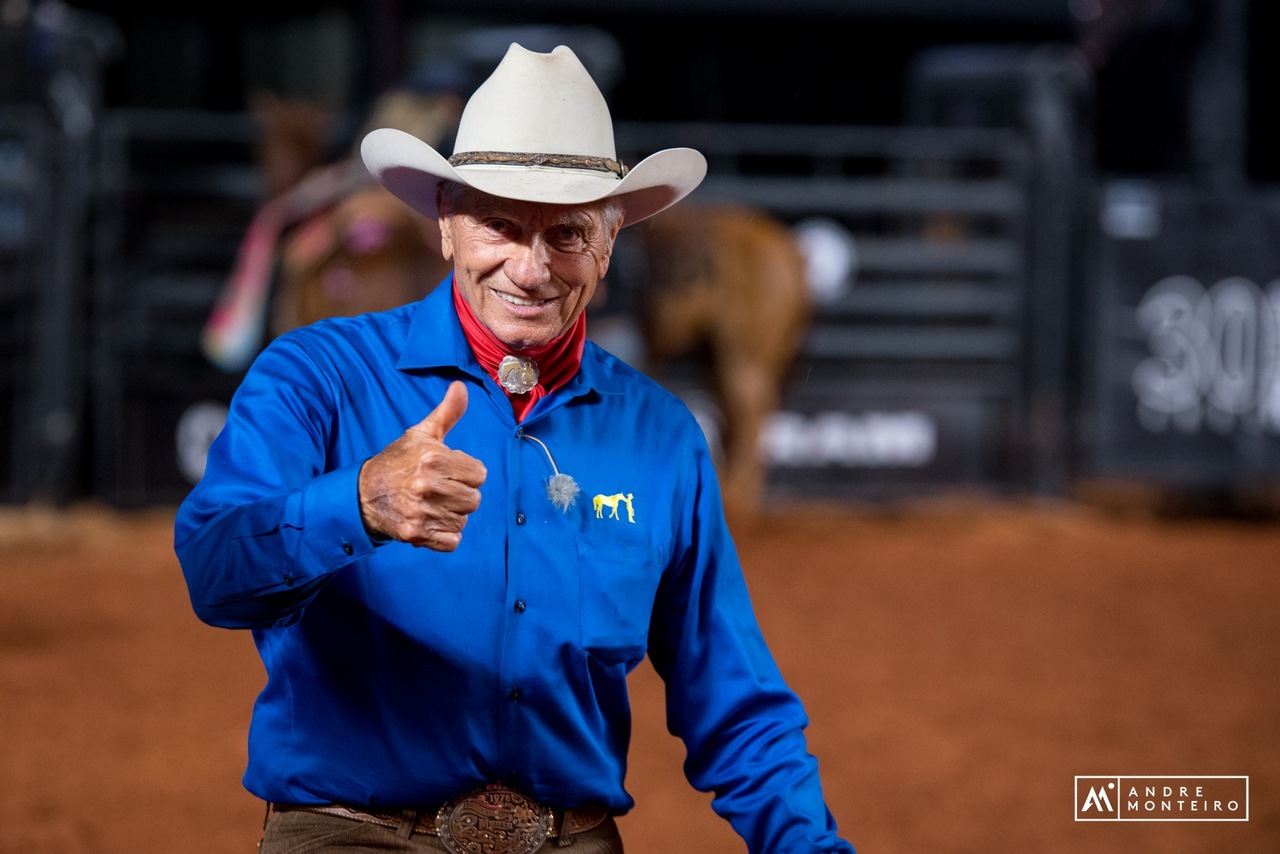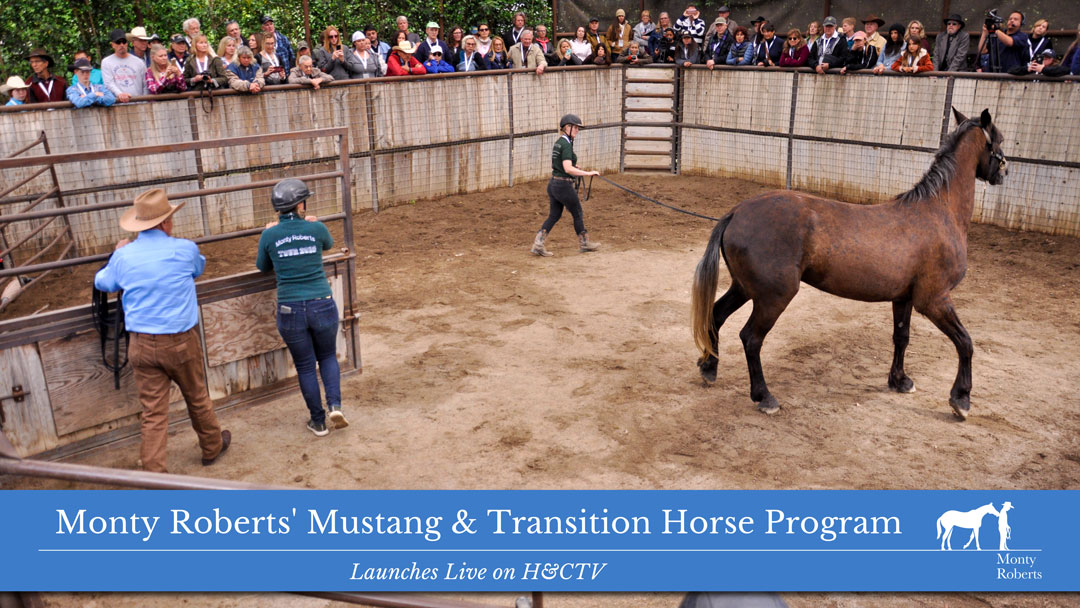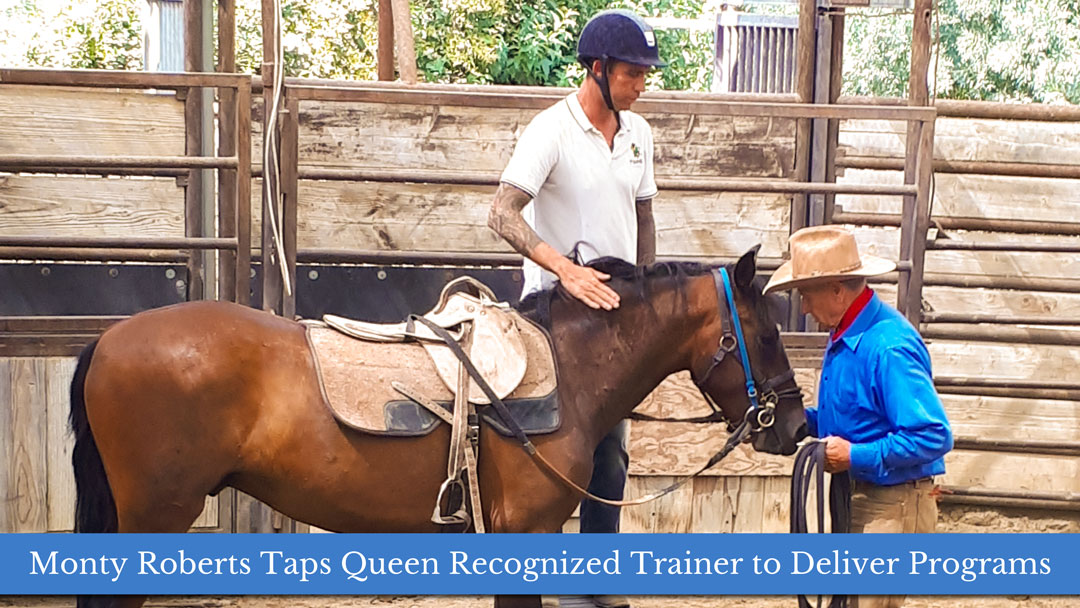
“I am very proud to be a part of Her Majesty’s horse training and her passion for their welfare. I believe she is the leading monarch for the advocacy of horses in the world. She is a thought leader in this field. My Dually Halter is seen throughout this footage, making a difference in the training of sensitive animals by giving the horse the choice to partner in the training.” Monty Roberts
Archive for the ‘Latest News’ Category
The Queen’s Passion for Horses
Friday, June 7th, 2013
Upcoming Monty Roberts Special Training Workshop
Thursday, June 6th, 2013Come and discover what horses have to teach us about building lowering stress, and building trust at the Monty Roberts Special Training to be held at Flag Is Up Farms, in Solvang, California, from August 5-9, 2013.
“This intensive five-day training is the perfect environment for connecting with peers who know that horses have a lot to teach us”, commented Monty’s daughter and staff member Debbie Roberts-Loucks. “You will learn how Monty Roberts keeps stress out of his life with horses, and how to develop the motivation and resilience to achieve your life’s goals”, she added.
Roberts, the famous New York Times bestselling author of The Man Who Listens to Horses will share his life story about overcoming barriers, motivating yourself and lowering your stress levels to achieve your goals.
At the workshop, Monty will work with a range of young and remedial horses. By observing this unique and gifted man, participants will gain first-hand knowledge during demonstrations, lectures, and discussions. This class is for the novice rider, the non-rider, as well as the advanced student who wants to observe a master at work.
Monty will also demonstrate how to communicate with horses in their natural language in various situations during this intensive 5-day class. “The workshop is formatted to provide you with the educational tools you need to address leadership issues, ground manners, teaching to tie, crossing water (and/or obstacles), loading, head-shyness, mounting, bucking, standing for the farrier, kicking, and biting”, Roberts-Loucks continued.
This exclusive training program helps you better understand problem solving using Monty is violence-free training methods. Come and spend time with like-minded people absorbing what non-violent communication can be. Enjoy the included lunch and lively discussions too with Monty and students from around the world.
For more information, contact Flag Is Up Farms at (805) 688-3483 or805-688-6288 or email Maya@join-up.org
Monty Roberts Corporate Training Events
Thursday, May 30th, 2013Preparing for More Effective Presentations Using…
Horse Training?
By Dr. Susan Cain and Debbie Roberts-Loucks
We were lucky to be invited recently to a Huey Lewis concert, and then to go meet Mr. Lewis back stage prior to the show. We went to the show with Pat and Monty Roberts.
When we got to the concert venue, we were ushered backstage. There was quietness before the show-no sign of backstage jitters or stage fright by anyone about to go on stage. Someone asked Mr. Lewis what he did to prepare for his show. He looked around, adjusted his glasses and said simply, “Change my shirt.”
We liked that answer. It showed how lightly Mr. Lewis wore his fame, and reminded me that even high profile people have a choice in the way they prepare for an event or meeting. After that statement, Mr. Lewis took the stage and the audience readily responded to his low-key sincerity.
On another recent occasion, we spoke with a colleague, a fellow graduate school instructor. His words about how he prepared for each class struck us as useful. “I don’t worry about class time,” he related. ” I prepare for each class, then enjoy myself once in class,” he said. It struck us that Mr. Lewis had done just that-albeit with minimal last minute preparation.
Many of us have to prepare for what we perceive as high-pressure meetings. Our anxiety in the meeting can steer an otherwise good meeting toward a tense, pressurized encounter. We have an antidote to that scenario- a different way of putting anxiety into a more useful place. We suggest looking to horses for a solution.
For thousands of years of domestication, horses as flight animals have developed a keen sensitivity to human adrenalin levels. They know when anxiety levels are high in humans, and when they are low. According to New York Times Best Selling Author Monty Roberts, it is more useful for training (read, learning) when adrenalin and anxiety levels are lower. Mr. Roberts uses a process of training called Join-Up to establish a relationship with a horse that relies on trust to relax and enable the horse to learn. He mirrors the horse by using the horses’ own language of gestures-a language Mr. Roberts calls Equus.
“Adrenaline up, learning down, adrenalin down, learning up,” says Mr. Roberts about the usefulness of nerve-wracking learning encounters. How can this perspective inform your own preparation for presentations or training meetings? It’s simple, for your next presentation, try doing the following:
1. Prepare for your meeting or presentation to the point of complete comfort with the materials you will present.
2. Rehearse, role-play, practice. Know your material cold.
3. Once at your meeting, enjoy the company you are with and let your presentation roll out. Connect with your audience. Relax, breath normally, you know your stuff!
For your next presentation, try the above suggestion-use your nervous energy to drive meeting preparation and then relax once you are into the meeting. Enjoy. Your anxiety levels will be lower, and so will the anxiety levels of your audience.
Debbie Roberts-Loucks and Dr. Susan Cain design and facilitate unique corporate training events. Find out more about MPRI corporate training opportunities by visiting the corporate events page at www.montyroberts.com.
Obtain a copy of the workbook: Life Lessons from The Man Who Listens to Horses
Win a Chance to Ride with Monty!
Tuesday, April 16th, 2013Here is an exceptional opportunity for those of you in the USA!
By becoming a member of ACTHA you have a chance to win an all-expense paid trip, airfare included, to Monty’s farm and the opportunity to saddle up with Monty. Winners will be whisked away to California and will be treated to an equine experience they will never forget! Register with ACTHA to enter this incredible prize drawing: www.actha.us/register
A Night of Inspiration with Monty at Flag Is Up Farms
Tuesday, April 9th, 2013Saturday, September 21, 2013
Your group will be welcomed to beautiful Flag Is Up Farms to watch a Join-Up experience, Monty Roberts’ signature event. Witness firsthand the powerful relationship of trust and communication between a horse and a human. In this narrated event you will learn about Monty’s fascinating life journey from his early days as a rodeo rider to trusted advisor to the Queen of England.
Afterwards, enjoy an traditional barbecue dinner with author Monty Roberts and artist Pat Roberts in their hilltop home. At dinner, great conversations will emerge about the importance of trust, overcoming adversity, achieving your vision, and living strong at any age. This unforgettable experience will transform your group and allow them to connect to a living legend.
Click here to download the flyer: http://www.montyroberts.com/wp-content/uploads/2013/04/May18Web.pdf
Call (805) 688-6288 to reserve your spot at this inspirational event.
Fergus the Spooky Horse Asks Monty…
Thursday, March 28th, 2013The big word “desensitization” is proving challenging for Fergus the Horse! So he decided to seek professional help from Monty Roberts.
Dear Mr. Roberts,
I know most of your questions are from people, but I’d like to ask you something too, if that’s OK, because I’ve heard, and read, that you know some things about horses. You see, there’s a big human word that I’m having a great deal of trouble with: “Desensitize“. My people don’t say it to me, they say it to each other. What they say to me is: “Easy, does, it Fergus, it’s OK.” But it’s not OK! Because when they come to me saying that, they are tense and nervous, and I know they are going to show me something horrifying! It is going to be something that moves, makes suspicious noises, and wants to touch me. I’d rather leave, but I cannot because of the lead-rope that they’ve named “relationship”. Often, “relationship” is strained. I really want to relax and be an “Easy does it, Fergus…” but it is impossible because they themselves are not relaxed, and they want to “desensitize” me every day with something new and dreadful. I dream about it at night. This is really hard. Is there anything you can say to my people about “desensitize”?
Dear Fergus,
Thank you for (somehow) writing to me with your concerns. Most people think I help people with horse problems, but more often I help horses with people problems. I hope to help you get past this confusion about what we humans are asking of you, and why. When they say ‘Desensitize’, they want to help you worry less about spooky items you come across on the trail and in the yard. That’s a good thing, Fergus.
Being spooky is one of the most natural conditions in the world of equine behavior. Just as with so many terms in the horse world, it seems appropriate to define the term spooky. It seems important to me to be clear so that these words can be understood worldwide. We horsemen in America tend to say things like, “He sure is spooky.” We expect everybody to immediately understand that this means, ‘to be frightened.’
There is a big word in psychology for your fear of unfamiliar things, Fergus. The word is ‘neophobic’ which is a persistent and abnormal fear of anything new. Horses are neophobic but people can be, too. Young children like their world to remain constant and elderly people often cope using long established habits and don’t want to learn “new tricks”. You are big and strong, Fergus, and people worry you might hurt yourself, or them, if you “spook”. This is why they introduce you to new things. My goal is to help people learn to do this with adrenaline and heart rates that are low.
After my first book, The Man Who Listens to Horses, was published in 1996, I was asked to conduct demonstrations on a worldwide scale. One of the remedial problems brought to me on a regular basis was “the spooky horse.” While I had dealt with this sort of training for more than fifty years, I had no idea how serious the condition was until I began to travel extensively. Cases representing fear of plastic bags, birds, airplanes, trucks, tractors, umbrellas, cattle, sheep, hogs, and even the fear of bicycles, were brought to me on a regular basis.
The plastic shopping bag has become the definitive object to assist me in desensitizing the horse to objects that cause him to spook. They are extremely light and therefore can’t physically cause the horse any harm. I attach several bags to one end of a discarded rake handle (a small wooden pole approximately 1.5 meters or five feet in length). You can train the bag to go away Fergus. Here’s how.
After you and your human have accomplished a Join-Up, they show you the plastic bag on a stick. It will be scary at first, but when you relax and accept it, they will take the bag away and relax. You can too. When I do this with horses, soon I can swing a massive collection of plastic bags at the horse evoking no flight response. And soon the horse will accept other scary objects if I stay relaxed and he trusts that nothing painful will happen.
Recognizing that we are dealing with the true nature of the horse will soon produce a non-spooky individual. It is important to eliminate blame from the mind of the trainer. I instruct my students that the horse can have no fault in these matters and with that mindset one can expect positive results.
Over the past 20 years the more than 8000 horses I have dealt with in front of public audiences have virtually all come to me with a spooky mindset. I think that it is fair to say that there have been no failures. It’s important that we humans respect your nature, Fergus, and your right to fear unfamiliar objects while you journey to overcoming spookiness.
Sincerely,
Tuesdays with Monty on HRTV
Tuesday, March 19th, 2013
Are You Too Old for Horses?
Tuesday, March 19th, 2013Question: Do you think with age come limitations in being able to become a better rider/ handler? I ask this because I am 46 years old and up until I bought Honey 5 years ago I hadn’t ridden or handled a horse in more than 20 years. I always think there is so much more to learn about horses but I wonder if I have left it all too late. I came to see Monty at a demo recently and it made me realize that it has taken him a lifetime to get where he is today and you too have had a wealth of experience.
Monty’s Answer: Thank you for sending through this question inquiring as to the potential for becoming a good horse person at the age of 46. Given recent experiences I’ve had, I’m very pleased to answer this question, as I believe that it has the potential to help many ladies and gentlemen too. To give you my feelings on this subject I would like to eliminate myself, as much as possible, from the scenario.
My life on a horse’s back began well before I could speak and it has been seven decades now of intense riding and the studying of horsemanship and equine behavior involving many disciplines and virtually all breeds. It is my students and acquaintances that I would like to report on. First let me say that I appreciate your concern and I hear within your question an attention to safety and what you can physically expect to accomplish.
This is a good attitude and we should always respect the potential for moving forward only when we’re as safe as possible and as comfortable as we can be with the activity that we’re pursuing. Having said that, let me state categorically that I consider 46 to be a child. It is important that if there are years of reduced physical activity then it is a good idea to get one’s body in the best shape possible.
Pilates and other forms of core stability fitness can be a tremendous advantage in the area of safety and even enjoyment. Getting fit is great for one to enjoy their middle years and riding horses is simply a bonus in terms of increasing the potential for pleasure in those years. Do not lose sight of the fact that the choice of a safe horse is critical. Furthermore, the assistance of knowledgeable coaching is a major factor.
The right coach will see to it that you are equipped appropriately which is another factor that definitely needs to be attended to if you are to enjoy your activity and remain safe while conducting it. One should do strong diligence on the individual chosen to assist in this effort and they should have significant experience with horses and the coaching of riders as well. If you desire to take up riding again, then with the above-mentioned factors in place, you should charge into the project with great excitement. It can be a wonderful experience, as I will point out using two of my acquaintances as examples.
Charlotte Bredahl was born in Denmark, rode as a child and came to the United States in 1979. She had been studying dressage and was considered a potential for high-level performance in her chosen discipline. Charlotte went to work in her 20s and made the US Olympic Team. She was the recipient of the bronze medal in dressage in the 1992 Barcelona Olympics. After returning to the US, Charlotte put riding on the back burner.
As a realtor, Charlotte placed business at the peak of her interest and while she rode it was not her primary activity. Charlotte lives near our property in California and I watched in the past two years as she moved back into the area of serious horsemanship. Charlotte is now well over 50 and I watched her riding high-level dressage today. She is now riding five top class dressage prospects each day and having a lot of fun with it.
Charlotte emphasized the fact that she worked hard at getting fit again and I can attest to the fact that she is in fantastic shape now, feels well and is having the time of her life with her favorite past time. It is a pleasure to watch Charlotte ride. The second example that I am choosing to bring to you is an acquaintance that, to me, demonstrates amazingly well the answer to your question. The subject lady is 76 years of age at this writing.
She rode occasionally through her teens and then took up, principally, Western pleasure riding in her 20s. She rode occasionally until 1970. At the age of 34 she launched a successful career as an artist. Our subject remained a popular artist and is to this day. In 2009 at the age of 73, she decided not only to ride again, but also to ride in Western competition.
She did get herself in good physical condition and acquired a horse that was appropriate for her. She enlisted top notch coaching as well. This past year with three years completed in her reentry into riding our subject vintage lady won a year-end championship in the Western division of nonprofessional “Working Cow Horse.” This means that she was working cattle at top speed and under conditions that would be considered challenging for anyone including riders in their 20s.
She stated to me that she feels she is riding better now than she ever did in those early years of her horsemanship. She told me that she was now able to actually think things through more clearly and learn at a greater pace than she ever could in those early years. She respects her need for safety and has competed without negative incident.
It is important for me to state that these are two extreme examples. I am not suggesting that anyone, man or woman, needs to include competition with their riding, whether it is the beginning of their career or, as in this case, a reentry later in life. One may choose to ride strictly for pleasure or enter into activities that are slightly competitive, or, in fact, full on competition and as long as it is safe and enjoyable, I am all for it. In England, one of the slightly competitive activities is BHS Trek. There are many more fun elements of horsemanship, which are only slightly competitive. Probably the most often activity chosen is to simply ride with friends for the fun of it.
At 77 I can say that I feel myself still learning and I still ride. It is my opinion that while I can’t physically do many of the things that I did in my early professional career, I can understand the mental processes of learning better now than I ever could. Someone coined the phrase, “Use it or lose it” and I think that this is a fair statement to make. Your question gives me the chance to advise many individuals in that mid-life range that horses and riding can be a part of extending life and causing our vintage years to be more enjoyable if we choose to treat it with respect. I gave you two examples but believe me there are thousands out there, “Go for it, girl.”
Monty’s Horse Sense for the Work Place
Monday, January 28th, 2013Monty Roberts Transfers his Concepts of Trust-Based Accountability to the Work Place
Monty Roberts has teamed up with The Corporate Learning Institute to create Horse Sense for Organizations. New York Times best-selling author Monty Roberts is serious about transferring his concepts of trust-based accountability to the work place. Monty and Pat Roberts, Inc. (MPRI), and The Corporate Learning Institute have just announced the launch of a brand new series of business development services, Horse Sense for Organizations. The new services offer a window into Monty Roberts’ life, with its success stories and setbacks as case studies.
“We are launching a series of workshops, retreats and resources aimed at applying Monty’s lessons to the workplace,” Monty Roberts’ Vision Strategist Debbie Roberts-Loucks stated. The four new workshops and retreats include an exciting night with Monty Roberts showcasing his equine discoveries, an organizational development how-to, leadership development training and a team building workshop. Each workshop will focus on the trust-based accountability process that Monty developed for horses.